About Us
We provide ecological solutions to deliver carbon and nature recovery outcomes combatable for a future climate.
Carbon in Nature accounting
Site & Project Carbon Baselines for Natural Assets.
Peatland site evaluation & Restoration plans
Ecological Surveys
Climate Change Vulnerability & adaptation response plans.
Landscape Scale Conservation Facilitation and Support.
Environmental land management (ELM) Scheme implementation such as PA1's & PA2's etc.
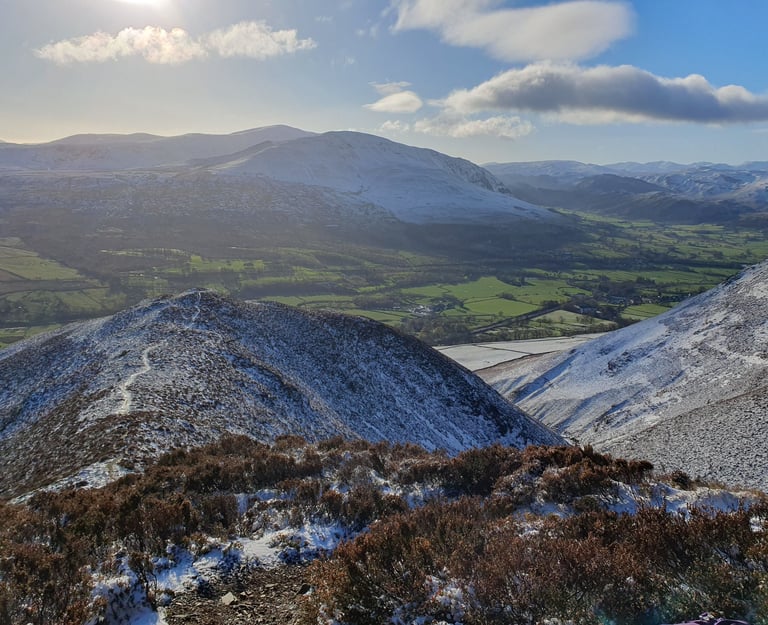
Committed to restoring nature and combating climate change.
Meet Ian Crosher
Ian is an CIEEM qualified Chartered Environmentalist (CEnv) with over 30 years experience encompassing many aspects of Ecology, Nature Recovery, Climate vulnerability and Carbon in Nature. Previously (until 2025) A Climate, Carbon, Peatland and Nature Recovery Specialist at Natural England with over a decade delivering agri-environment schemes.
Surveying and recommending habitat and ecosystem restoration on most habitats and locations around the UK, with a focus on the uplands and peatlands across the UK. I surveyed across Cumbria survey the majority of habitats while working on the ESA & HLS schemes.
I am a specialist in Climate Change with a recent focus around carbon in Nature. As well I have worked at a national strategic level on Biodiversity 2020 and Peatland Recovery, peat emissions and restoration.
Developing much of the understanding and evidence base around carbon in nature and spatial data. Net zero and nature recovery of certain ecosystems and approaches can deliver better carbon outcomes than others.
Feeding into the Landscape Recovery scheme, development of the scoring criteria particularly on carbon and climate resilience.
I Spent a year developing the Net Gain Framework through Biodiversity Metric v2 (Crosher et. al. 2019), mainly on the technical ecological aspects, how to set out the habitat classification, on time to target and habitat and feature condition.
Developed much of the ecological underpinning of the Nature Recovery Network. Which builds from the development of the Ecological Networks Handbook that got abbreviated into the Nature Networks Evidence Handbook.
Development of the Habitat Networks Maps to set out how we can join and connect habitat patches to spatial represent the ‘Making Space for Nature’ principles. Within Biodiversity 2020 I was the lead for Outcome 1D: Restoring at least 15% of degraded ecosystems as a contribution to climate change mitigation and adaptation.
Through this ran initial workshops that developed much of the initial work and concepts that help establish the natural ecosystem function work and development of the floodplain wetland mosaic concepts.
Represented the England on a number of EU work streams around CBD target 15 (now target 2, degraded ecosystems) of the CBD implementation 2011- 2020.
Writing the initial study on the Cumbria High Fells but then going onto develop the NW Regional CC Vulnerability landscape Assessment.
Some of the published outputs, I have been majorly involved in developing & writing.
• Nature Net Zero (NECR 569) [2025]
• Climate Mitigation and England Peatlands (NERR142) [2025]
• Carbon Storage and Sequestration by Habitat 2021 (NERR094) [2021]
• Spatial Prioritisation of Land Management for Carbon Datasets [2023]
• Nature Networks Evidence Handbook (NERR081) [2020]
• The Biodiversity Metric 2.0 – Technical supplement (Crosher 2019, et. al)
• The Biodiversity Metric 2.0 – User Guide (Crosher 2019 et.al.)
• Habitat Network Maps – data layers and framework development.
• Developing Datasets for Biodiversity 2020: Outcome 1D
Contact Details
Old School House,
High Hesket,
Cumbria
Phone
enquires@natureclimatesolutions.co.uk
+44 7966 760 460
© 2026. Nature Climate Solutions. All rights reserved.